
No Quit. No Corners Cut. How JDI Contracts Engineers Projects Through the Hard Parts
Updated: Jun 4
Most companies can talk about engineering. Fewer can talk about accountability once fabrication starts, timelines slip, inspections get uncomfortable, or unexpected problems show up on-site.
That’s where projects stop being theoretical.
And that’s where JDI Contracts does its best work.
Recently, the JDI team traveled to Georgia to inspect a large ASME-coded industrial tank tied to one of its process skid projects. On paper, it sounds straightforward: inspect the vessel, verify compliance, move the project forward.
In reality, projects like this are where engineering, project management, quality assurance, and problem-solving all collide at once.
Engineering Beyond the Drawings
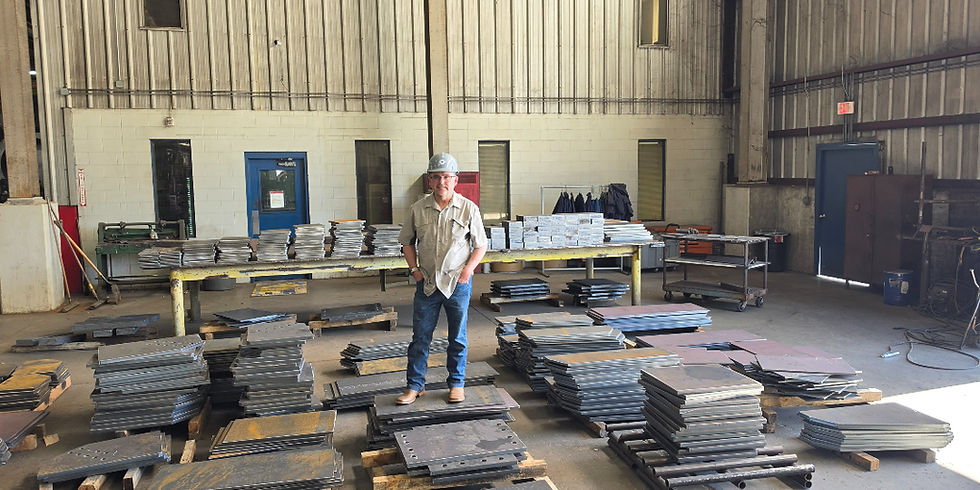
The tank itself stands roughly 40 feet tall and integrates with a custom industrial skid designed by JDI Contracts. While the tank fabricator handles structural calculations and vessel certification, the process begins long before steel is cut.
JDI’s role starts at the design level.
That means working directly with clients to determine:
Nozzle locations and elevations
Electrical and cable routing requirements
Insulation considerations
Lightning protection
Safety tie-off points
Installation and lifting provisions
Site constructability improvements
Integration with surrounding systems
Every decision affects how the system will eventually operate in the field.
Once the design package is complete, JDI coordinates with fabrication partners who perform the engineering calculations required for ASME certification and produce fabrication drawings. From there, the review process becomes collaborative and highly detailed.
“We’re constantly evaluating whether what’s being built matches the operational intent of the project,” one JDI engineer explained. “The goal is transparency and delivering the best possible product to the client.”
Inspections That Go Beyond Minimum Requirements

What separates JDI Contracts is not just engineering capability. It’s the willingness to stay involved after the drawings leave the office.
During the Georgia trip, the team conducted multiple rounds of inspections — including additional dimensional verification work that exceeded the minimum project requirements.
The first inspection involved internal weld reviews inside the vessel itself.
The second focused on dimensional accuracy:
Verifying nozzle placements
Confirming rotational alignment
Checking elevations and tolerances
Reviewing fabrication consistency against approved drawings
The final inspection involved hydrostatic testing — the last major step before ASME certification.
During hydro testing, the vessel is filled with water and pressurized above its operating rating while inspectors monitor for leaks or pressure loss. Because water is non-compressible, the process is significantly safer than using compressed gas during certification testing.
If the vessel holds pressure successfully, it receives ASME approval as a coded vessel.
Not every engineering firm stays this involved in fabrication quality.
JDI does.
“We’re not wearing engineering hats during inspections,” the team explained. “At that point, we’re trying to be completely objective. Does the vessel match the drawings? Does it meet the standards? Are there any discrepancies that could create problems later?”
That level of oversight matters — especially on complex industrial systems where installation delays, safety concerns, or fabrication errors can become expensive very quickly.
Solving Problems Without Slowing the Project

One moment during the inspection process captured exactly how JDI approaches difficult projects.
After hydro testing was completed, an inspector identified an incomplete weld profile on a safety platform brace. Structurally, the issue was minor. But visually and procedurally, it needed to be addressed.
The complication: once hydro testing is complete, welding directly on the pressure boundary of the vessel is heavily restricted.
Instead of creating delays, scrapping work, or forcing unnecessary rework costs, the team worked through the problem, identified a compliant solution, coordinated with fabrication partners, and kept the project moving.
That’s the difference between simply identifying problems and engineering solutions.
“Even when things go wrong, we usually find a way to make things right without adding major cost,” the engineer said.
Complex Projects Require More Than Technical Skill

Industrial projects rarely move in perfect straight lines.
Schedules shift. Construction timelines change. Site readiness evolves. Fabrication hurdles appear. Client priorities move.
This project has had its share of challenges, but the JDI team never framed that as failure. They framed it as the reality of doing difficult work well.
“There have been numerous hurdles,” the engineer admitted. “But that’s part of this industry. We’ll come out of it having learned a lot, and that’s a win.”
That mindset matters.
Because clients are not just hiring a vendor. They’re hiring a team that can navigate uncertainty without losing momentum.
The JDI Difference
At its core, JDI Contracts positions itself as more than an engineering firm.
The company operates at the intersection of:
Engineering
Fabrication coordination
Quality assurance
Project management
Field execution
Client transparency
And when projects get difficult, the team keeps moving.
As one team member describes the JDI Contracts culture, “we don’t have any quit in us.”
That may be the clearest description of JDI Contracts there is.


Comments